


Could the latest federal housing policies and Edmonton's changing zoning rules affect your home's value?
Updated November 10, 2026 | REMAX River City
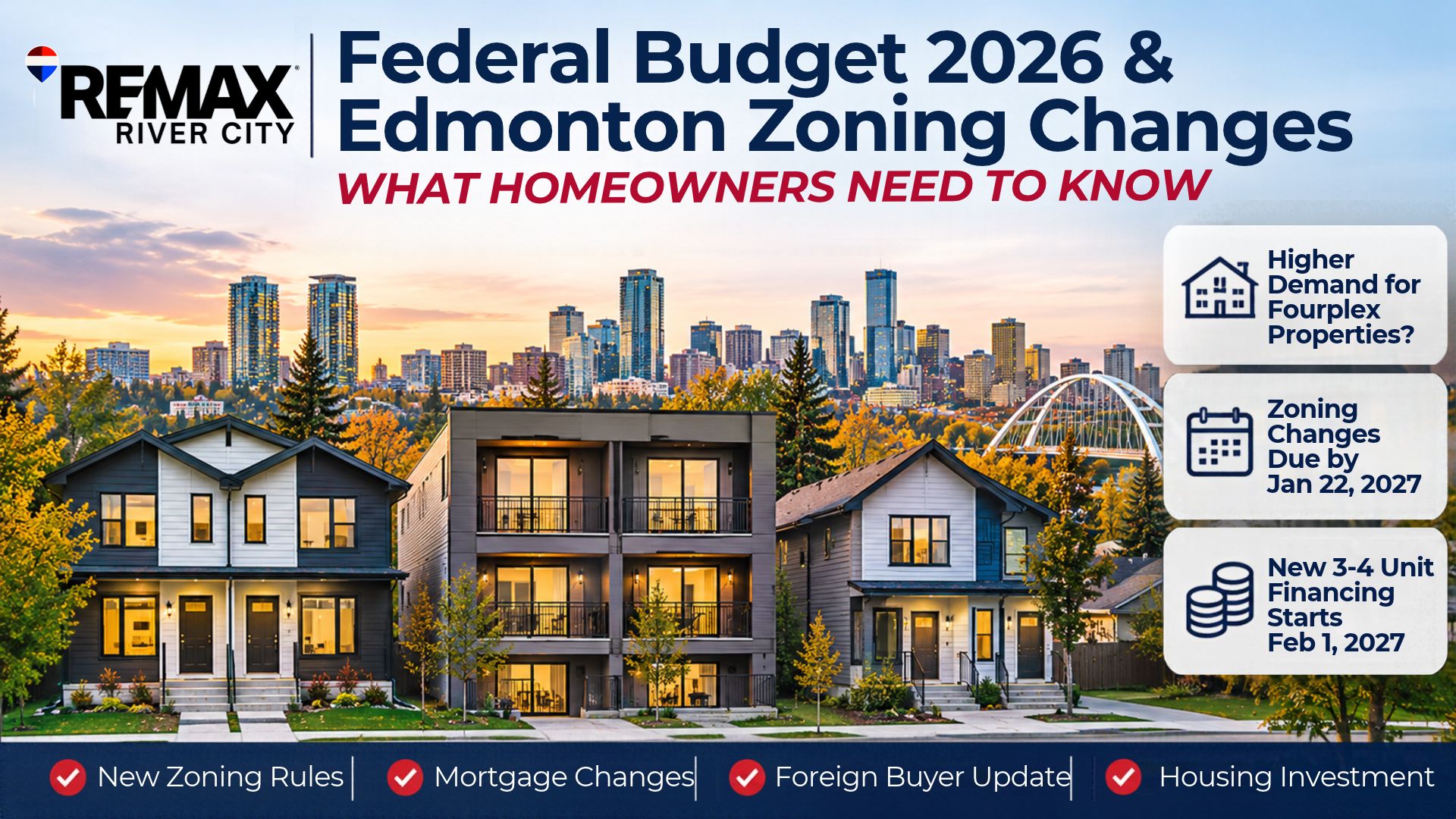
Canada's 2026 Federal Budget, released November 5, includes several housing measures that could influence Edmonton's real estate market heading into 2027.
At the same time, the Alberta government's direction to reverse parts of Edmonton's residential zoning framework is creating new questions for homeowners, builders and investors.
Together, these developments could change how certain properties are financed, developed, purchased and valued.
Here are six key changes Edmonton homeowners should understand.
1. Edmonton Zoning Changes Could Reshape Demand for Fourplex Properties
One of the biggest local developments isn't in the federal budget at all.
In October 2026, the Alberta government directed Edmonton to amend parts of its residential zoning rules by January 22, 2027, including returning certain density, height and parking requirements to earlier standards.
Edmonton's current zoning framework allows a variety of small-scale residential developments. The provincial directive introduces uncertainty about which configurations will remain permitted on individual lots.
That matters because Edmonton has experienced substantial interest in infill housing, including duplexes, basement suites, garage suites and fourplexes.
What types of properties are we talking about?
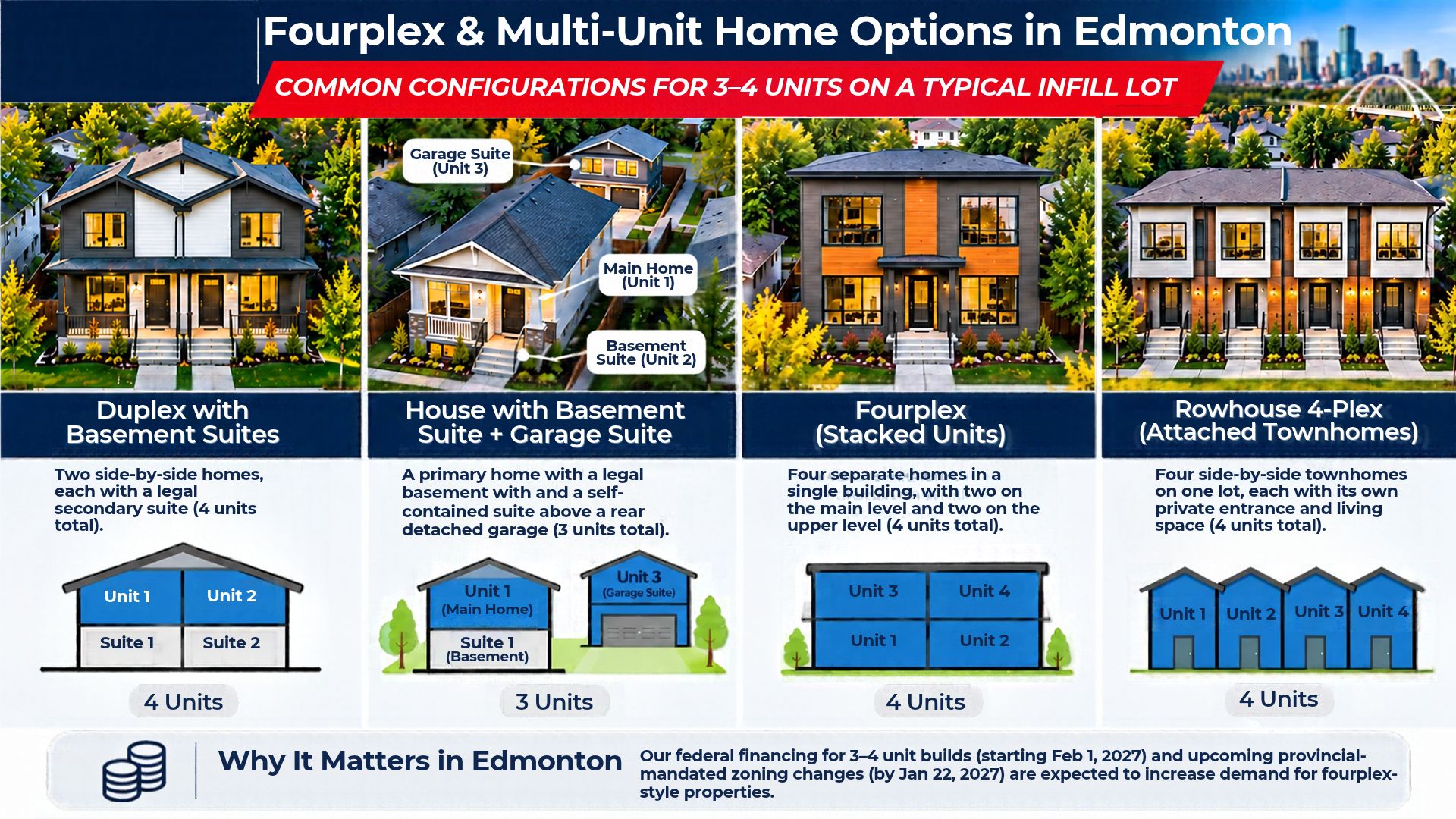
Common Edmonton infill configurations include:
Duplex with basement suites: Two side-by-side homes, each with a separate legal basement suite, creating four units.
House with basement suite and garage suite: A primary residence, a legal basement suite and a separate suite above a detached rear-lane garage, creating three units.
Stacked fourplex: Four self-contained homes within one building, with two on the lower level and two above.
Rowhouse fourplex: Four attached townhomes, each with its own entrance and living space.
Why this could affect Edmonton property values
Our expectation is that the combination of new federal financing opportunities and more restrictive zoning on certain lots could increase investor interest in properties with existing legal multi-unit configurations or confirmed development potential.
For example, an older home on a desirable infill lot may attract buyers who are interested in its redevelopment potential rather than just the existing building. However, the zoning rollback could also reduce the number of units permitted on some properties. That makes it especially important to distinguish between what a lot can accommodate today and what may be permitted after January 2027.
Our outlook: Well-located properties with confirmed three- or four-unit development potential may become increasingly desirable, particularly if financing becomes more accessible. But not every lot will benefit, and owners should verify zoning, permits, servicing and development feasibility before assuming additional value.
2. Foreign Buyers May Be Allowed to Purchase Newly Built Canadian Homes
The federal government is proposing a significant change to Canada's foreign-buyer restrictions.
Under Budget 2026:
Restrictions on purchases of existing and resale residential properties by non-Canadians would be extended to January 1, 2029.
Qualifying newly built residential properties would be exempted from the federal prohibition, subject to legislation and implementation rules.
This could create additional opportunities for Edmonton developers selling new detached homes, townhomes and condominium units.
Why Edmonton could benefit
Edmonton remains an attractive market for buyers seeking comparatively affordable housing, rental investment opportunities and access to a growing metropolitan economy.
Opening qualifying new construction to a broader international buyer pool could increase demand for certain projects, particularly those marketed to overseas purchasers.
However, the size of that potential increase is uncertain.
Edmonton's International connections
Statistics Canada's 2021 Census identifies the following top five countries of birth among recent immigrants arriving in the Edmonton census metropolitan area between 2016 and 2021:

Important distinction: These statistics describe immigration origins, not foreign real estate purchases. Many newcomers are Canadian permanent residents or citizens who may already be eligible to purchase property. The data does not establish which countries will generate future foreign investment.
Nevertheless, it demonstrates Edmonton's strong international connections and the importance of serving buyers from diverse backgrounds.
Our outlook: The proposed exemption could support demand for newly constructed homes and potentially encourage additional development. It does not mean all foreign buyers can immediately purchase all types of Edmonton real estate.
Source: Statistics Canada, 2021 Census of Population, Edmonton CMA, recent immigrants by place of birth.
3. New Insured Financing Could Make Three- and Four-Unit Projects More Attractive
For Edmonton builders and real estate investors, this may be one of the most significant housing measures in Budget 2026.
Beginning with mortgage insurance applications submitted on or after February 1, 2027, eligible newly built three- and four-unit properties can access expanded insured financing.
The announced parameters include:
Up to 90% loan-to-value based on projected completed property value.
No maximum property value cap.
No requirement for the borrower to live in one of the units.
Up to 30-year amortization for eligible completed-property mortgages.
The changes also permit private mortgage insurers to provide coverage for qualifying buildings with five to fifty units, expanding financing options for larger rental developments.
An Edmonton fourplex investment example
Consider a newly built fourplex with four rental units.
Assuming an illustrative monthly rent of $1,900 per unit:
A three-unit property at the same rental rate would generate $5,700 per month, or $68,400 annually.
These are gross rental income illustrations, before vacancies, operating expenses, financing costs, property taxes, insurance, maintenance and management.
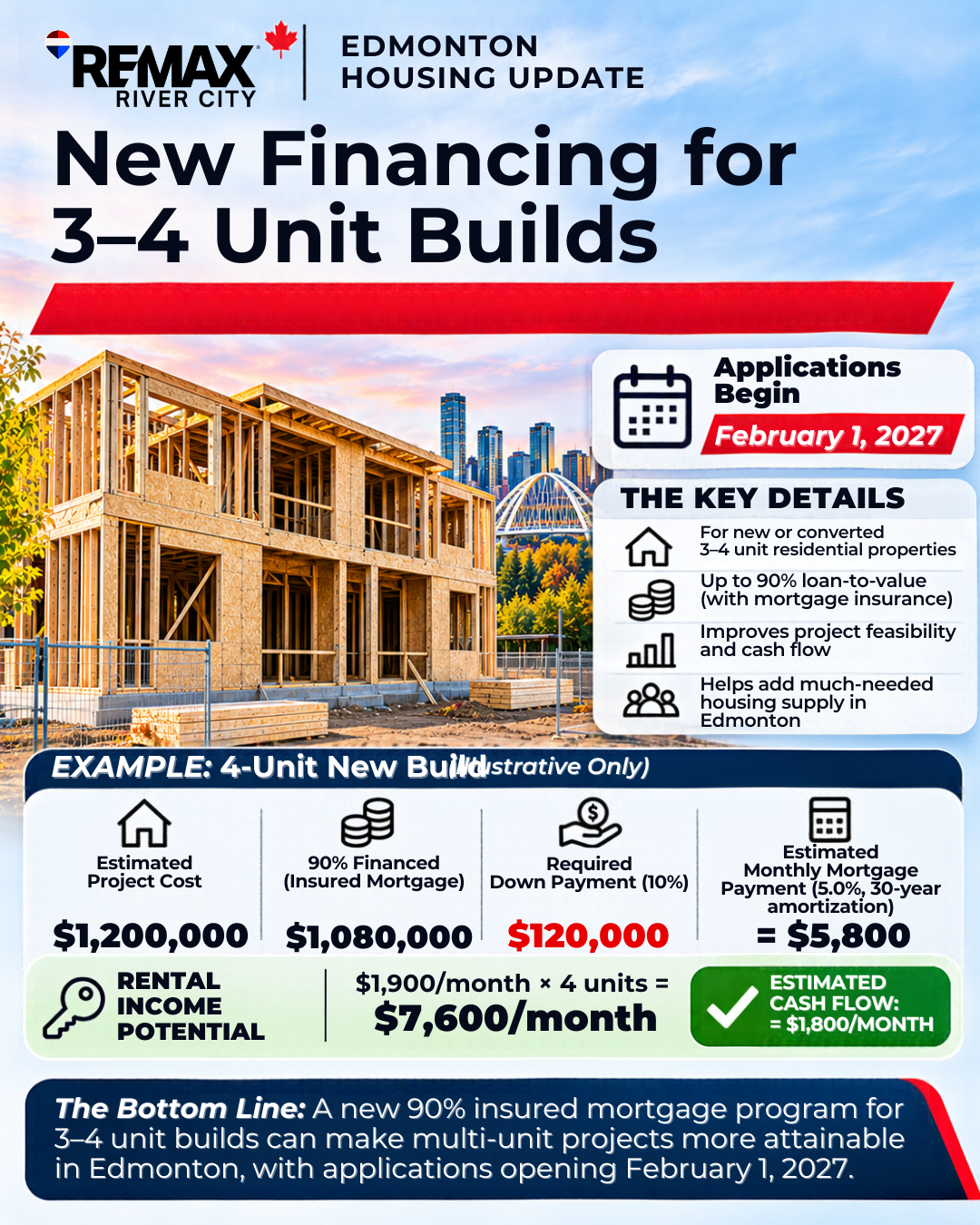
The important change is that qualifying builders and investors may have access to insured financing with a lower equity requirement relative to the completed property's value.
That could help more small-scale residential projects become financially feasible.
A word of caution: The 90% figure is a maximum permitted loan-to-value ratio, not guaranteed financing. Lenders and insurers will still assess the borrower, project economics, construction risk and repayment capacity. Construction-stage underwriting also differs from permanent mortgage financing.
Our outlook: This could create meaningful opportunities for Edmonton's small builders and investors, particularly those focused on three- and four-unit infill developments.
4. Longer Mortgage Amortizations Lower Payments — But Increase Total Interest
The federal budget also highlights expanded access to insured mortgages with 30-year amortizations and a $1.5 million insured mortgage home-price ceiling.
These measures build on mortgage rule changes introduced previously, rather than representing entirely new eligibility for every buyer.
For qualifying first-time homebuyers and purchasers of newly built homes, longer amortization periods can reduce monthly payments and improve cash flow.
But there's a trade-off.
Example: A $500,000 Edmonton Home
Assume a buyer purchases a $500,000 property with a $100,000 down payment, leaving a $400,000 mortgage.
At an illustrative 4.5% interest rate:
The longer amortization reduces the monthly payment by approximately $197, but increases total interest by approximately $62,000.
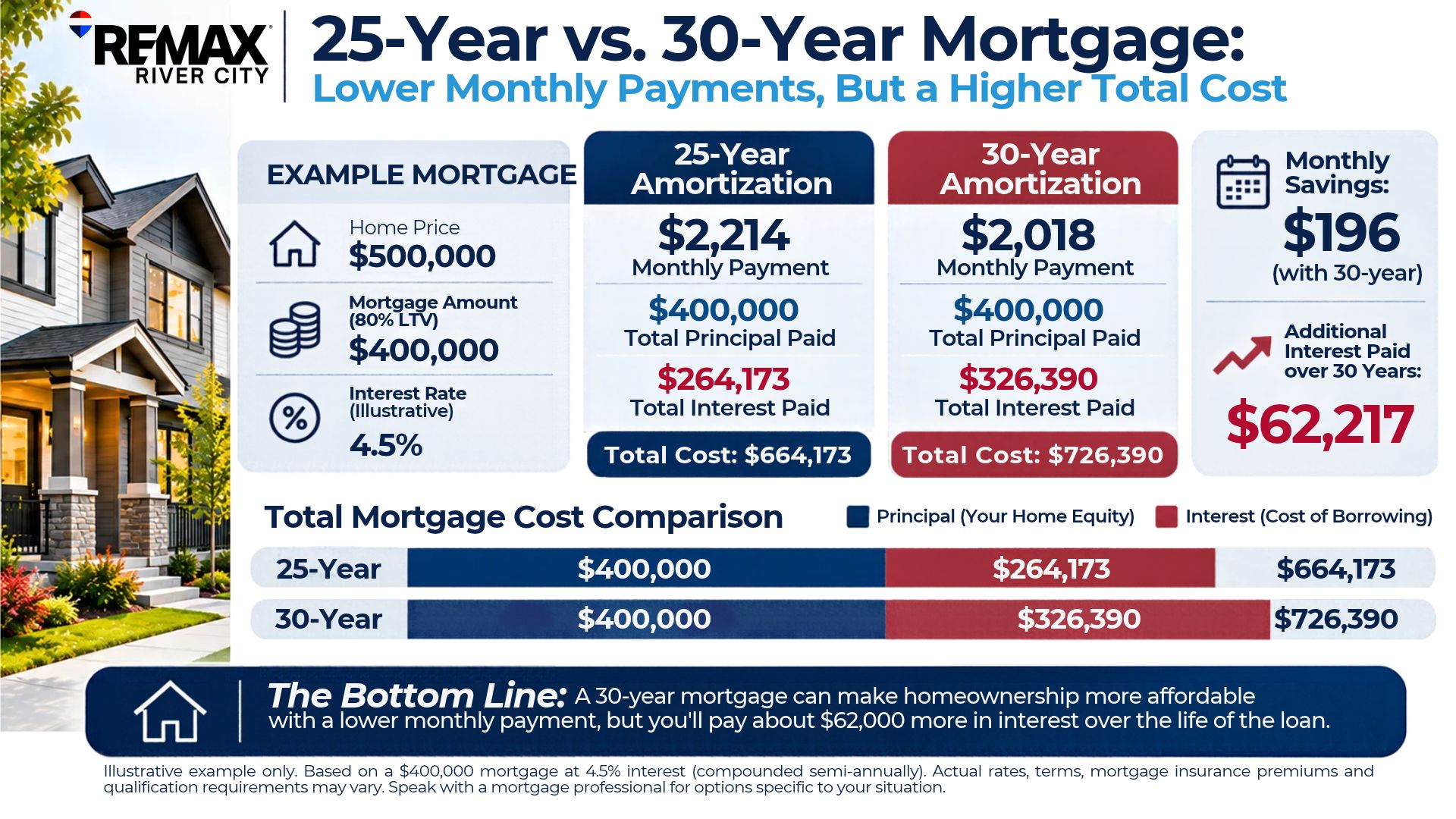
For some buyers, the lower payment may be worth the additional long-term borrowing cost. Others may prefer to pay down their mortgage faster.
These examples assume a constant interest rate throughout the amortization period and exclude mortgage insurance premiums and other borrowing costs. Actual Canadian mortgage rates typically change at renewal.
Our advice: Choose a mortgage based on affordability, long-term financial goals and flexibility—not simply the lowest monthly payment.
5. Build Canada Homes Plans Up to 355 New Homes at Edmonton's Village at Griesbach
Budget 2026 includes major federal housing investments intended to increase supply and improve affordability.
One project with a direct Edmonton connection is the planned Build Canada Homes development at the Village at Griesbach.
According to the federal government's project backgrounder, the development could include up to:
300 apartment-style homes in multi-family buildings.
55 additional residential units on a second parcel.
355 homes in total, with at least 40% intended to be offered below market value.
The project is expected to explore modern construction methods, including prefabrication, modular construction and mass timber.
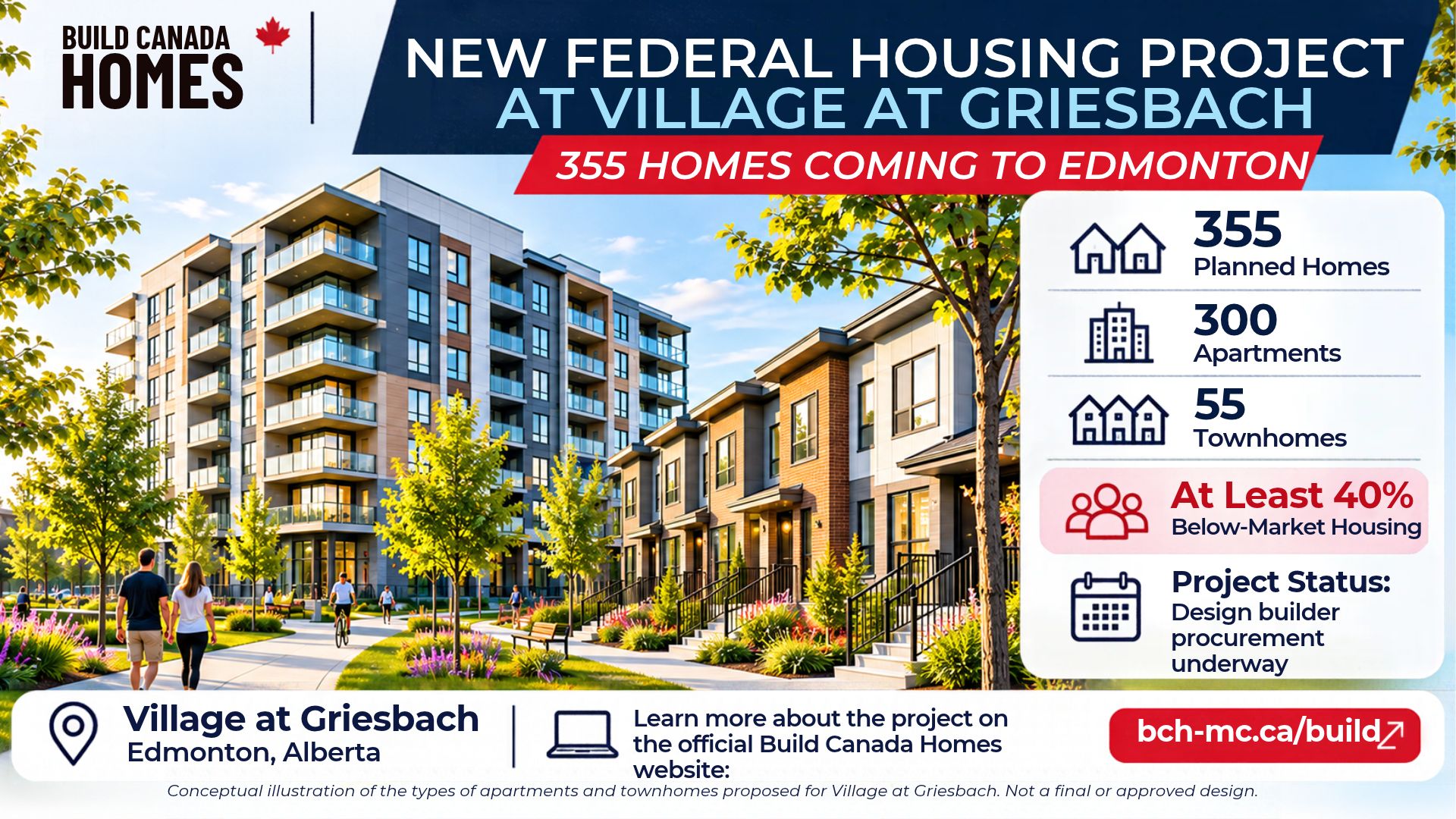
The project is still subject to its development and procurement processes. The accompanying illustration is conceptual and should not be interpreted as a final approved architectural design.
What does this mean for Edmonton homeowners?
Additional housing supply can improve affordability and give buyers and renters more choices.
It may also create increased competition for some existing rental properties, particularly where new developments offer comparable units at competitive prices.
For homeowners, the effects will vary by neighbourhood, property type and the pace of construction.
Our outlook: New housing investment is positive for Edmonton's long-term growth, but individual property values will continue to depend on local supply, demand and economic conditions.
Official project information: Build Canada Homes
6. What Could These Changes Mean for Your Edmonton Home's Value?
Taken together, these policies create several possible trends heading into 2027.
For existing homeowners: Properties with legal secondary suites, multiple rental units or confirmed redevelopment potential may attract additional investor attention.
For sellers: Understanding your property's zoning and legal development potential could become an increasingly important part of positioning and pricing your home.
For buyers: New construction options and longer mortgage amortizations may create additional purchasing opportunities, although eligibility and affordability remain important.
For investors and builders: Expanded insured financing may improve the economics of certain three- and four-unit projects. But construction costs, rental income, interest rates and zoning restrictions must still support the investment.
For landlords: Additional rental supply may increase competition in some segments, making property condition, tenant experience and rental pricing increasingly important.
Our Edmonton Housing Market Outlook for 2027
We believe one of the most interesting opportunities to watch will be the intersection of zoning, financing and development potential.
Properties that can legally accommodate three or four residential units—and can be developed at a financially viable cost—may become especially attractive to investors.
At the same time, increased construction activity and new housing supply could moderate price or rent growth in certain segments.
The key is understanding the specific property and neighbourhood, rather than assuming every Edmonton home will respond to these changes in the same way.
Frequently Asked Questions
Will Edmonton's zoning changes increase my property value?
Possibly, but not automatically. Value will depend on your property's zoning, location, existing improvements, legal suite status and redevelopment potential. Some properties could lose permitted density under the provincial directive.
Can I build a fourplex on my Edmonton property?
That depends on the zoning and development rules applicable to your specific lot, as well as servicing, setbacks, parking and other requirements. With changes expected by January 22, 2027, it is important to confirm current and proposed regulations before proceeding.
Can I get 90% financing to build a fourplex in Edmonton?
New federal mortgage insurance parameters allow up to 90% loan-to-value financing for qualifying newly built three- and four-unit properties, with applications beginning February 1, 2027. Approval remains subject to lender and insurer requirements.
Can foreign buyers purchase new homes in Edmonton?
Budget 2026 proposes exempting qualifying newly built homes from the federal foreign-buyer prohibition. The change requires implementation before buyers can rely on it, and other eligibility rules may apply.
Is a 30-year mortgage better than a 25-year mortgage?
A 30-year amortization generally offers lower monthly payments but higher lifetime interest costs, assuming the same rate. The better choice depends on your financial situation, eligibility and long-term objectives.
Will new housing developments lower Edmonton home prices?
Not necessarily. New supply can reduce housing shortages and improve buyer choice, but prices are also influenced by employment, population growth, mortgage rates, construction costs and demand in individual neighbourhoods.
Get Local Advice Before Making Your Next Real Estate Decision
Whether you're considering selling an older home with redevelopment potential, buying a new construction property, investing in a fourplex or simply trying to understand how these changes could affect your home's value, local expertise matters.
At REMAX River City, our REALTORS® work with Edmonton homeowners, buyers, sellers and investors across a wide range of property types.
Our brokerage also offers access to agents who support clients in 30 languages and communication options, reflecting the diverse communities we serve.

We're also proud to be a Miracle Office, supporting the Stollery Children's Hospital Foundation and the children and families who depend on it—one real estate transaction at a time.
Thinking about your property's future?
Connect with a REMAX River City REALTOR® to discuss your property's current market value, development potential and the opportunities that may emerge in Edmonton's changing housing market.
Local knowledge. Personal service. Confident decisions.
Sources and Further Reading
Statistics Canada — 2021 Census of Population, Edmonton Census Metropolitan Area, recent immigrants by place of birth.
Disclaimer: This article provides general market commentary and information as of November 10, 2026. Some measures are proposed or subject to future implementation. Financing examples are illustrative and are not mortgage commitments or investment projections. Readers should confirm current zoning, lending, legal and tax requirements with the appropriate professionals.


Comments:
Post Your Comment: